Views: 0 Author: Site Editor Publish Time: 2026-03-06 Origin: Site
Are you experiencing unexplained clunking when you press the gas pedal? Do you notice terrifying play in your steering wheel? Perhaps you feel strange vibrations scaling up as you drive faster. If you hold a repair estimate mentioning an Intermediate shaft, you probably feel confused. Mechanics use this technical term often, but they rarely explain its actual function. We want to demystify this critical component for you today.
Whether it lives inside your lower drivetrain or connects your steering column, this shaft acts as a vital structural bridge. It connects power sources to output points while absorbing intense kinetic energy. Understanding this part helps you make highly informed repair decisions. We will shift away from dense mechanical definitions now. Instead, we offer a pragmatic evaluation of failure symptoms. You will learn about costly misdiagnosis risks and real-world cost considerations. By the end, you will know exactly how to handle your vehicle's repair confidently.
An intermediate shaft serves as a flexible bridge, either balancing drivetrain power (managing angles and NVH) or connecting the steering wheel to the steering gear.
Misdiagnosing an intermediate shaft issue as a CV axle failure is a common, costly mistake in repair shops.
Intermediate shaft replacement is not a universal flat rate; costs vary significantly based on labor accessibility and whether the vehicle is front-wheel, rear-wheel, or four-wheel drive.
Material quality (e.g., heat-treated splines) matters heavily when sourcing an intermediate shaft for American car platforms (often heavy-duty/RWD) versus an intermediate shaft for Japanese car designs (often symmetrical FWD layouts).
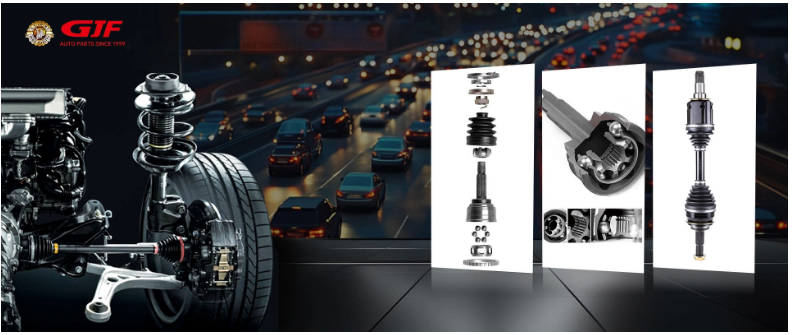
The automotive industry frequently recycles terminology. This creates massive confusion for everyday drivers. Mechanics use this specific term to describe two entirely distinct, highly critical vehicle systems. Quickly establishing this disambiguation prevents you from buying the wrong replacement part.
Drivetrain Intermediate Shaft (Stub Shaft): This sturdy metal rod spans the physical gap between your transmission or differential and your drive wheels. It continuously manages dynamic suspension angles. As your wheels bounce over potholes, this shaft absorbs the shock. Automotive engineers rely on it to reduce NVH (Noise, Vibration, and Harshness). It connects to your wheel assemblies using U-joints or Constant Velocity (CV) joints.
Steering Intermediate Shaft: This slender component lives under your hood. It firmly connects your steering wheel to the lower steering rack. Engine bays are incredibly crowded spaces. A straight rod cannot easily reach the steering rack without hitting engine blocks or exhaust manifolds. This shaft maneuvers around engine bay obstacles using small universal joints, acting like a flexible elbow.
Why do automotive engineers avoid using a single long shaft? Long solid metal shafts suffer from physical limitations. They remain highly prone to extreme vibration and torque flexing. Imagine spinning a very long, thin wooden dowel rapidly. It will inevitably bow and whip violently in the middle. Splitting an axle and adding a center support bearing completely solves this engineering challenge. It creates a flexible elbow ensuring smooth, uninterrupted power delivery. It also guarantees seamless steering input under extreme dynamic loads.
Repair shops operate under tight time constraints. Mechanics frequently confuse a failing CV axle with a drivetrain intermediate shaft failure. This happens because both parts physically connect to each other. They share the exact same load environments under the chassis. When dirt enters the joint area, pinpointing the exact source of an audible clunk becomes difficult.
Approving a blind parts-swap costs hundreds of dollars in wasted labor. You must know how to isolate the issue accurately. We can differentiate these failures by carefully analyzing specific driving symptoms.
| Diagnostic Criteria | CV Axle Failure Symptoms | Intermediate Shaft Symptoms |
|---|---|---|
| Primary Audible Noise | Distinct clicking or popping sounds. | Deep, heavy clunking sounds. |
| Condition Trigger | Occurs only when turning sharply at low speeds (e.g., parking). | Occurs during straight-line acceleration or deceleration. |
| Vibration Characteristics | Mild steering wheel shimmy under heavy loads. | Severe, whole-vehicle vibrations scaling directly with vehicle speed. |
| Visual Indicators | Visible thick grease leaks from torn rubber boots. | Worn rubber isolators on center support bearings; rusty splines. |
| Secondary Noises | None typically. | Constant humming or growling from worn center support bearings. |
Best practices dictate a manual physical inspection. You should instruct your mechanic to place the vehicle on a hydraulic lift. Ask them to physically grab the shaft and check for lateral play in the machined splines. They must also inspect the center bearing for torn rubber. Never approve a costly CV axle swap without verifying these specific connection points first. Taking ten extra minutes to manually inspect the splines prevents completely unnecessary repairs.
Ignoring suspension or steering noises guarantees catastrophic collateral damage. A failing shaft does not heal itself. The physical manifestations of impending failure scale rapidly. Eventually, ignored wear destroys adjacent components. You might damage your transmission output seals, leading to massive fluid loss. Worse, you could experience sudden steering loss at highway speeds.
Watch out for these specific safety and risk indicators. We categorize them based on the specific system failing.
Aggressive shuddering under load: When you press the accelerator hard, the entire cabin violently shakes. This indicates the center support bearing has completely collapsed.
Metal-on-metal grinding: You hear a terrifying crunching noise when shifting from reverse into drive. This noise indicates stripped splines. The transmission turns, but the shaft slips. Complete loss of motive power is imminent.
Transmission fluid pooling: Severe shaft vibrations destroy the delicate rubber seals located on the transmission casing. You will spot red fluid puddles under your parked vehicle.
Steering wheel tilt locking mechanism fails: Your steering wheel suddenly drops into your lap while driving. It refuses to lock into your preferred vertical angle. This represents an extreme safety hazard demanding immediate roadside assistance.
Steering wheel binds or turns roughly: The universal joints connecting the shaft have dried out or rusted. You feel distinct "notches" or heavy resistance points when turning the wheel.
Fails to return to center: After completing a sharp turn, the steering wheel should naturally glide back to the center position. If it stays stuck in the turned position, your steering linkages are dangerously binding.
When you receive a repair estimate, the total figure might shock you. We need to break down exactly why an intermediate shaft price fluctuates so drastically. Your total cost of ownership (TCO) depends entirely on your vehicle's specific drivetrain layout and the quality of the replacement part.
Labor realities dictate the final invoice more than the metal part itself. Front-Wheel Drive (FWD) layouts present unique challenges. Accessing the shaft often requires draining the transaxle fluid completely. Mechanics must also remove heavy lower suspension components just to gain clearance. This makes FWD repairs incredibly labor-heavy. Conversely, Rear-Wheel Drive (RWD) and Four-Wheel Drive (4WD) layouts are typically more accessible from under the chassis. However, they frequently involve replacing heavy-duty center support bearings simultaneously, which drives up the parts total.
Approaching an intermediate shaft replacement requires strategic thinking. You must choose between OEM parts and premium aftermarket alternatives. Always avoid bottom-tier, unbranded aftermarket parts. Cheap manufacturers skip critical metal tempering processes.
You should prioritize components featuring CNC-machined splines. Precision machining guarantees a perfect fit, eliminating microscopic play. Furthermore, insist on heat-treated steel construction. Heat treating ensures the new part matches or perfectly exceeds Original Equipment (OE) tensile strength. High-quality materials secure your long-term ROI and permanently prevent premature re-repair.
Replacement criteria change fundamentally based on your vehicle's engineering origin. Automotive engineers from different global regions prioritize different structural goals. Understanding these nuances ensures you purchase the correct specification for your exact chassis layout.
When sourcing an intermediate shaft for Japanese car models, your focus shifts toward compact efficiency. Brands like Honda and Toyota dominate the high-efficiency FWD transaxle market. Their primary design purpose centers on equalizing the physical length of the left and right CV axles. Symmetrical axle lengths eliminate "torque steer"—that dangerous pulling sensation you feel under hard acceleration. Therefore, precision balancing and lightweight structural integrity serve as your top buying criteria. A poorly balanced aftermarket shaft will instantly introduce highway-speed vibrations into a lightweight Japanese chassis.
Conversely, sourcing an intermediate shaft for American car platforms requires evaluating raw structural durability. American manufacturers like Ford, Chevy, and GMC produce massive RWD muscle cars, heavy-duty SUVs, and high-capacity pickup trucks. Their design purpose focuses on managing immense high-torque outputs. They must handle aggressive driveshaft angles over exceptionally long wheelbases. Durability ranks above all else. You must evaluate replacement parts based on thicker gauge steel and robust center support bearing compatibility. Splines must withstand massive towing payloads without shearing.
Ignoring a worn intermediate shaft might save you a few hundred dollars today. However, it absolutely guarantees catastrophic transmission, differential, or steering failure tomorrow. Delaying repairs converts a simple parts swap into a multi-thousand-dollar drivetrain rebuild. You now possess the knowledge to confidently identify failure symptoms and distinguish them from basic CV axle wear.
Perform a visual inspection: Safely lift the vehicle and physically check for abnormal play in the splines or torn center bearings.
Evaluate steering feel: Immediately stop driving if your steering wheel binds, refuses to center, or drops from its locked tilt position.
Demand premium parts: Source a replacement shaft explicitly featuring heat-treated steel components and exact OE-matching spline counts.
Expect alignment needs: Factor a professional four-wheel alignment into your budget if your mechanic dismantles FWD suspension components during the repair.
A: Engineers split long axles to prevent extreme vibration and structural whip. A single long solid metal rod bows under high-speed rotation. Splitting it into two pieces with a center support bearing creates a flexible joint. This allows your suspension to articulate smoothly over bumps while transferring power efficiently.
A: No. Driving with a failing steering shaft poses a severe safety risk. Worn universal joints can suddenly bind, making the steering wheel impossibly stiff. If the connections fail entirely, you will instantly lose total vehicular control. We strongly advise against driving until a professional replaces the part.
A: It heavily depends on your drivetrain. Replacing a drivetrain shaft on an FWD layout usually requires dismantling lower control arms and suspension hubs. This disrupts your factory geometry, making an alignment highly recommended. Conversely, replacing a steering shaft inside the cabin rarely requires a subsequent wheel alignment.


