Views: 0 Author: Site Editor Publish Time: 2026-04-21 Origin: Site
In the complex world of automotive engineering, few components are as fundamental yet as frequently confused as the drive shaft and the axle. While both are critical for transmitting torque, their roles, designs, and failure symptoms are distinctly different. Misidentifying them can lead to incorrect repairs, wasted time, and compromised vehicle safety. The effective transfer of power from the engine to the wheels is the heart of a vehicle's performance, and understanding each link in this chain is essential for technicians, parts suppliers, and enthusiasts alike. This article provides a definitive technical and commercial framework to distinguish these components, empowering you to make informed decisions for repair, procurement, and design.
Direction of Power: Drive shafts transfer power longitudinally (front-to-back), while axles transfer power transversely (side-to-side) to the wheels.
Component Complexity: A drive shaft assembly often includes U-joints and slip yokes, whereas a drive axle (specifically CV axles) utilizes constant velocity joints and boots.
Drivetrain Dependency: FWD vehicles typically lack a traditional drive shaft, relying on a transaxle and half-shafts; RWD and AWD vehicles require both.
Procurement Focus: High-performance or heavy-duty applications require specific material evaluations (carbon fiber vs. steel) and balancing certifications.
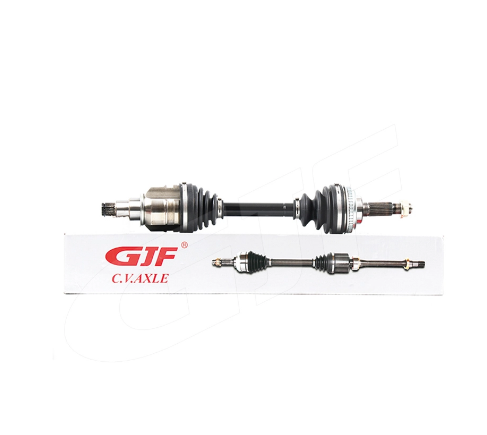
At the heart of the drive shaft versus axle debate is one simple principle: the direction of power flow. One acts as a long-distance conduit, while the other handles the final, local delivery. Understanding this functional difference is the first step in correctly identifying parts and diagnosing issues within any vehicle's drivetrain.
Think of the Drive Shaft, often called a propeller shaft, as the primary bridge in a rear-wheel or all-wheel drive system. Its main job is to transmit rotational force, or torque, from the vehicle's transmission to the differential. This component spans a significant length of the vehicle's undercarriage, running from front to back. Because the rear differential moves up and down with the suspension, the drive shaft must be engineered to handle constant changes in angle and length. This is accomplished through universal joints (U-joints) and a slip yoke, which allow it to flex and slide without interrupting power delivery.
The drive axle represents the final stage of the drivetrain. After the drive shaft delivers power to the differential, the differential splits that power and sends it out to the wheels via two drive axles. These components work transversely, or side-to-side. Each drive axle connects the differential to a wheel hub, delivering the torque that makes the wheels turn. Unlike the long, central drive shaft, axles are shorter and are located at the front, rear, or both ends of the vehicle, depending on the drivetrain configuration.
Front-wheel drive (FWD) vehicles present a notable exception that often fuels confusion. In an FWD layout, the engine, transmission, and differential are all combined into a single, compact unit called a transaxle. This design is located at the front of the vehicle. Since the power source is already at the drive wheels, there is no need for a long, longitudinal drive shaft to transfer power to the rear. Instead, FWD vehicles use two shorter drive axles, often called half-shafts or CV axles, to send power directly from the transaxle to the front wheels.
Beyond their functional roles, drive shafts and axles have fundamentally different designs, materials, and components. Their construction is tailored to the unique stresses they endure, from high-speed rotation over long distances to managing the sharp angles of a steering wheel.
A drive shaft is engineered for high-speed rotation while minimizing vibration and weight. Its key anatomical features reflect these goals.
Tubular Design: Most drive shafts are hollow tubes. This design significantly reduces rotational inertia and overall weight compared to a solid bar of the same strength. Lower inertia means the engine can spin it up to speed more quickly, improving throttle response.
Materials: The choice of material for an Auto Drive Shaft depends on the application. Steel is the most common for its durability and low cost. Aluminum offers considerable weight savings for performance vehicles. Carbon fiber is the premium choice for high-torque racing applications, as it provides exceptional strength and dampens vibrations.
Couplings: Universal joints (U-joints) are critical components. These cross-shaped joints are located at each end of the drive shaft, allowing it to transmit power smoothly even when the transmission and differential are not perfectly aligned. A slip yoke allows the shaft's length to change slightly as the suspension travels.
A drive axle is built for high torsional strength to handle the immense force required to turn a wheel. Its design is more compact but equally sophisticated, especially when it must accommodate steering.
Solid vs. Hollow: Most drive axles, particularly those in FWD vehicles (CV axles), are solid steel bars. This provides the maximum torsional strength needed to withstand the twisting forces of acceleration and braking in a short span.
-
Constant Velocity (CV) joints are the defining feature of modern front axles. Unlike U-joints, which have a slight speed fluctuation as they rotate at an angle, CV joints deliver a perfectly consistent rotational speed to the wheels, even during sharp turns. This prevents shuddering and vibration, which is crucial for a smooth driving experience.
Integrated Components: A modern drive axle is more than just a steel bar. It often includes an ABS reluctor ring, which the anti-lock brake system sensor reads to monitor wheel speed. It is also protected by flexible rubber or thermoplastic boots that hold grease and keep out contaminants. A torn boot is the most common cause of CV joint failure.
| Attribute | Drive Shaft | Drive Axle |
|---|---|---|
| Primary Function | Transfers torque from transmission to differential (longitudinal) | Transfers torque from differential to wheel hub (transverse) |
| Typical Construction | Hollow tube | Solid steel bar |
| Key Joints/Couplings | Universal Joints (U-joints), Slip Yoke | Constant Velocity (CV) Joints |
| Common Materials | Steel, Aluminum, Carbon Fiber | High-strength alloy steel |
| Associated Drivetrains | RWD, AWD, 4WD | All (FWD, RWD, AWD, 4WD) |
The type of drivetrain your vehicle uses—RWD, FWD, or AWD/4WD—is the single most important factor in determining which components it has and where they are located. Correctly identifying the drivetrain layout is the first step in ordering the right parts.
This is the classic configuration. An RWD vehicle features a single, long drive shaft running down the center of the vehicle. It connects the transmission at the front to the differential at the rear. The rear differential then powers two rear axles, which turn the back wheels. This setup is common in trucks, performance cars, and many luxury sedans. Identifying a drive shaft here is straightforward—it's the only long rotating shaft visible under the center of the car.
As mentioned, FWD vehicles consolidate the powertrain at the front. They do not have a long, central drive shaft. Instead, they use two drive axles, commonly called CV axles or half-shafts, to send power from the transaxle to the front wheels. This is where the most common terminology mix-up occurs; consumers and even some technicians may mistakenly call a CV axle a "drive shaft." It's crucial to use the correct term, CV axle, when sourcing parts for FWD cars to avoid confusion.
These are the most complex systems. An AWD or 4WD vehicle has components of both RWD and FWD systems. They require a transfer case, which receives power from the transmission and splits it between the front and rear of the vehicle. Consequently, they typically have:
A rear drive shaft (like an RWD car) to power the rear differential.
A front drive shaft to power the front differential.
Two front drive axles (CV axles) to power the front wheels.
Two rear drive axles to power the rear wheels.
This complexity has significant commercial implications. For businesses, managing Wholesale Drive Shaft inventory requires stocking parts for RWD, AWD, and 4WD systems. The SKU complexity is much higher, as drive shafts and axles vary in length, spline count, and material based on the specific vehicle model and configuration.
When a drivetrain component begins to fail, it provides distinct auditory and sensory clues. Learning to differentiate between the symptoms of a failing drive shaft and a failing drive axle is key to a swift and accurate diagnosis.
Because a drive shaft is long and centrally located, its failure symptoms are often felt throughout the entire vehicle.
Intense Floorboard Vibrations: The most common symptom is a vibration that can be felt in the floor and seats. This vibration typically starts at a certain speed and gets worse as you accelerate. It's often caused by a worn U-joint or an imbalanced shaft.
"Clunking" Sounds: A loud clunk or clang when you shift from drive to reverse, or vice versa, often points to excessive play in a U-joint or the slip yoke.
Squeaking at Low Speeds: A consistent, bird-chirping squeak at low speeds can indicate a dry, failing U-joint that needs lubrication or replacement.
Axle failure symptoms are usually localized to one corner of the vehicle and are often most noticeable during specific maneuvers.
Rhythmic "Clicking" or "Popping" Noises: A rhythmic clicking sound that appears or gets louder during sharp turns is the classic sign of a worn outer CV joint. A left turn will stress the right CV joint, and vice versa.
Grease Splatter: If you see dark, heavy grease on the inside of your wheel or on nearby suspension components, it's a clear indication that a CV boot has torn. This allows the protective grease to escape and contaminants to enter, leading to rapid joint failure.
Shuddering During Acceleration: A vibration or shudder that occurs only during acceleration can be a sign of a worn inner CV joint.
Ignoring these symptoms is extremely dangerous. A failing U-joint can eventually seize, or the drive shaft itself can detach from the vehicle. This can cause a catastrophic "unzipping" of the drivetrain at highway speeds, leading to a total loss of control. Similarly, a broken CV axle will leave you stranded as the engine's power can no longer reach the wheel. Prompt diagnosis and repair are not just about performance; they are critical for safety.
When it's time for a replacement, choosing the right part involves more than just matching the part number. Decisions about OEM versus aftermarket, new versus remanufactured, and supplier quality can have a long-term impact on performance and cost.
Original Equipment Manufacturer (OEM) parts are guaranteed to fit and perform to the factory standard. They are often precision-balanced to minimize vibration. Aftermarket parts can offer significant cost savings, but quality can vary. When choosing an aftermarket Drive Shaft Assembly, it's vital to select a reputable brand that certifies its products for proper balance and material strength to avoid introducing new vibrations or risking premature failure.
For repair shops and distributors, sourcing parts in bulk requires a strategic approach. Key metrics for evaluating suppliers should include:
Torsional Strength Ratings: Ensure the parts meet or exceed OEM specifications for the intended application, especially for trucks and commercial vehicles.
Spline Count Accuracy: Mismatched splines will make installation impossible. Precision manufacturing is non-negotiable.
Rust-Inhibitive Coatings: A quality coating protects the component from corrosion, extending its service life significantly.
The "part-only" price is often deceptive. A cheap, poorly balanced drive shaft might save money initially but can cause costly damage to transmission seals and bearings over time. Similarly, some axle installations are very labor-intensive, especially when bearings must be pressed in and out of a steering knuckle. Factoring in the total cost—including labor and the risk of collateral damage from a low-quality part—is essential for making a sound financial decision.
Remanufactured parts can be a cost-effective and environmentally friendly option. A high-quality remanufactured CV axle will have its joints inspected, its housing cleaned, and new boots, clamps, and grease installed. However, the reliability of reground or polished internal components can be a concern. A brand-new assembly offers the peace of mind of all-new components, often with a better warranty, ensuring maximum durability and performance.
The rise of electric vehicles (EVs) is fundamentally reshaping the traditional drivetrain. The architecture of an EV eliminates many of the components we've discussed, leading to a new era of integrated power delivery systems.
Most modern EVs with central motors or motors at each axle do not have a traditional, long drive shaft. Because the electric motor can be placed directly at the point of power delivery (the axle), the need for a longitudinal shaft to transfer power from a front-mounted engine is gone. This simplifies the vehicle's design, reduces weight, and eliminates a source of mechanical loss and vibration.
The next evolutionary step is the e-Axle. This is a highly integrated unit that combines the electric motor, power electronics (inverter), and a gearbox/differential into a single housing. The e-Axle is a self-contained propulsion system that can be bolted directly into the vehicle's chassis to power the front or rear wheels. This modular design streamlines manufacturing and improves powertrain efficiency by minimizing the distance power has to travel.
The shift to e-Axles has profound implications for maintenance and repair. The mechanical complexity is drastically reduced; there are no U-joints to fail or slip yokes to lubricate. However, the electronic complexity increases. E-Axles rely on sophisticated cooling systems to manage heat from the motor and inverter. Diagnosis now involves checking sensor data and thermal performance as much as listening for mechanical noises. While there are fewer moving parts to wear out, the ones that remain are part of a more integrated and electronically complex system.
Distinguishing between a drive shaft and a drive axle boils down to a simple rule of thumb: drive shafts handle longitudinal (front-to-back) power transfer, while axles manage transverse (side-to-side) delivery to the wheels. This fundamental difference dictates their design, materials, and failure modes. For automotive professionals, mastering this distinction is not just a matter of terminology but a prerequisite for accurate diagnostics, efficient procurement, and reliable repairs. To ensure success, always follow this final checklist: verify the vehicle's drivetrain layout to identify the necessary components, match the material specifications to the vehicle's load and performance requirements, and always prioritize properly balanced assemblies to prevent vibrations that can lead to costly secondary damage.
A: It is highly discouraged. A vibrating drive shaft indicates a serious issue, such as a failing U-joint or imbalance. Continuing to drive can cause the vibration to damage the transmission's output shaft seal, leading to fluid leaks and severe transmission damage. In a worst-case scenario, the shaft could detach and cause a catastrophic accident.
A: A half-shaft is another name for a drive axle, specifically in a front-wheel drive or independent rear suspension context. It transfers power from the transaxle or differential to a wheel. It performs the function of an axle (transverse power delivery), not a drive shaft (longitudinal power delivery).
A: Carbon fiber is used in high-performance and racing applications for two main reasons. First, it is incredibly strong yet much lighter than steel, reducing rotational mass for better acceleration. Second, it has a higher critical speed—the speed at which a shaft can start to whip or resonate harmonically. This allows for higher RPMs without destructive vibrations.
A: A CV axle boot, made of rubber or durable plastic, can last anywhere from 80,000 to 120,000 miles. However, its lifespan is highly dependent on road conditions. Exposure to road debris, extreme temperatures, and sharp objects can cause it to crack or tear prematurely. Regular inspection during oil changes is the best preventative maintenance.
A: Yes, typically a 4WD or AWD vehicle has two separate drive shafts. The transfer case, which sits behind the transmission, splits power and sends it to both the front and rear differentials. One drive shaft connects the transfer case to the rear differential, and a second, shorter drive shaft connects it to the front differential.


